This blog serves as a complement to the first one I published on the Equipment Qualification functionality: Equipment Qualification – Part I. While the initial article introduced the fundamental concepts and the overall process logic, this new content dives deeper into additional aspects of the functionality, exploring another practical use case and more advanced configurations.
Additional Functionalities in Equipment Qualification#
In addition to the core process described in the first article, Equipment Qualification offers several advanced capabilities that enhance flexibility, operational control and allow us to use this functionality in more complex qualification scenarios.
1st) Triggering a Qualification After a Preventive Maintenance#
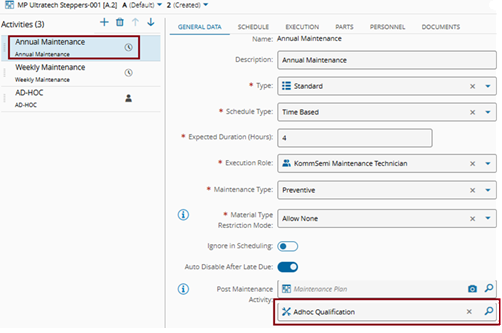
An Adhoc qualification may also be automatically triggered upon completion of a maintenance activity. In such cases, the equipment will remain unavailable until the qualification result is “Pass”. This capability is extremely important following annual maintenance for instance, during which multiple components may be replaced and/or process recipes updated, etc.
Annual Maintenance with Qualification
Alternatively, rather than triggering a qualification following a maintenance activity, it would also be possible to incorporate the maintenance tasks directly within the qualification process itself with all the known functionalities (Checklist, Data Collection, BOM, Certification, Documents, etc.)
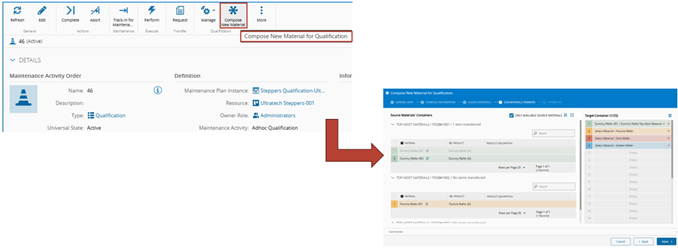
Assignment point is where Material assigned to the Qualification Procedure must be located. But what should be done if no qualification lot is available at that moment? Should we cancel the qualification until someone can create lots in the MES for this purpose? No! In these scenarios the system supports composing on the fly lots for this purpose. This allows users to dynamically generate the lots needed for the qualification without requiring preexisting master data setups.
Another option is to select a lot under an experiment to be sent to the assignment Step at the end of the experiment
The “Run at Risk” option enables shop floor operations to process a predefined set of lots on equipment that is currently undergoing qualification. This functionality may be used only under exceptional circumstances, in which an authorized user or role with the required permission determines that specific lots may proceed under these conditions. Typical use cases include urgent lots or lots that are known in advance to present minimal risk and are expected to be automatically placed on hold at a subsequent process step, with an associated protocol assigned for further evaluation.
4th) Minimum Quantity and Unit Selection for Lots#
When selecting lots for qualification, the system can ensure that a minimum quantity of units from the lot is provided to ensure that the qualification process is operationally valid. This control guarantees that the qualification is based on a sufficiently representative number of units. Additionally, users can choose whether the quantity is captured using the lot’s primary or secondary unit of measure, providing greater operational flexibility.
Qualification is triggered after a complex maintenance Activity. During the qualification a Dummy lot must be created on the fly, and some productive lots will Run at Risk whilst the equipment is still under qualification
The advanced capabilities of Equipment Qualification in CM MES make it easier to handle real-world manufacturing challenges. From triggering qualifications after maintenance to enabling controlled Run-at-Risk scenarios or creating material on the fly. These additional features ensure equipment remains compliant without slowing down operations too much. while still ensuring that equipment is properly checked and safe to use
I’ve been with Critical Manufacturing since 2018, starting out as an MES Consultant. In 2025 I stepped into the Advocate & Architecture team. My role sits at the intersection of technology, communication, and strategy. Making sure solutions are technically sound and that everyone understands how to use or build them.