Introduction
Etching Cluster Tools
Vendors often integrate multiple etch chambers into one platform and each chamber can run different etch chemistries.
Chambers may specialize in: oxide etch, nitride etch, metal etch, poly etch, high‑aspect‑ratio etch, etc. When one or more chambers go down, they can be removed from the Cluster to be repaired. This doesn’t mean a full production shutdown. Products that don’t depend on the capabilities of the affected chambers can still run.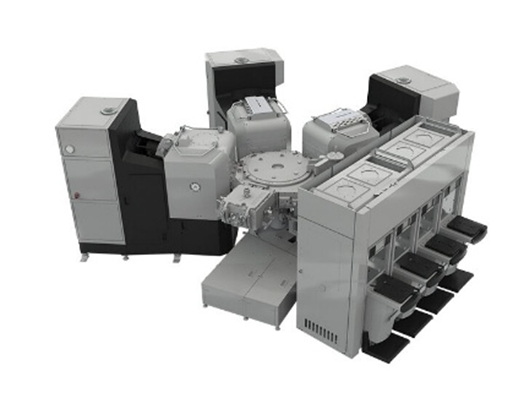
Sputtering or Metal Deposition Equipment
Sputtering tools are one of the clearest and most common examples of true cluster equipment in semiconductor fabs. They typically include:
- A central transfer module (Load Lock) with a robot
- Multiple process chambers, each performing a different metal deposition
- Each chamber can be independently used and repaired without stopping production.
Although more common in Semiconductor Industry, this scenario can also exist in other industries
Plasma Surface Treatment Tool for Medical Device Industry
Used for instance for catheter bonding prep, stent surface activation, syringe barrel cleaning. These equipment have typically a central load/unload, a set of plasma chambers in parallel and each one of them can run different gas recipes.
When one of the chambers is down and no alternative is available, some products that depend on that chamber may be forced to stop, while other products can continue to be manufactured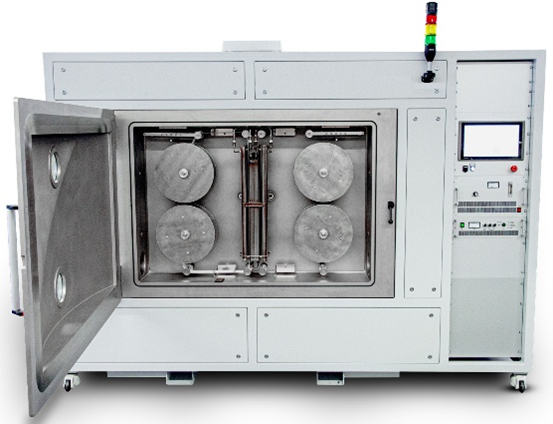
The use case shown in the demo below refers to the Metal Deposition process performed on a NEXX Sputter tool. Sputtering is a physical vapor deposition (PVD) technique widely used to deposit thin metal layers onto semiconductor wafers and it’s one specific technique of Metal Deposition process. It works by:
- Creating plasma
- Accelerating ions toward a metal target.
- Condensing those atoms onto a wafer, forming a uniform, high‑purity film.
Sputtering is ideal for a wide range of metals used in semiconductors industries, such as:
- Aluminum (Al)
- Copper (Cu)
- Zinc (Zn)
- Silver (Ag)
- And other materials
📝Use Case
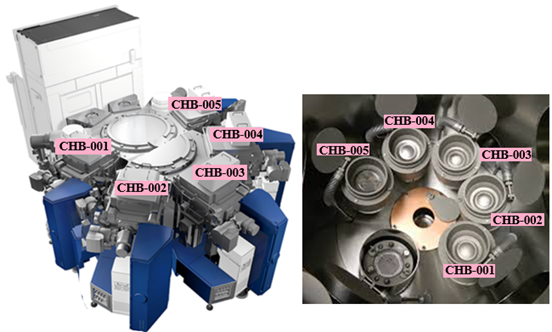
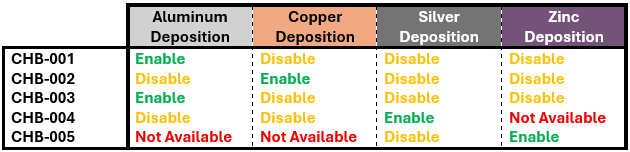

For product “KommSemi Generic Brand Gate Driver”, all the wafers require an initial silver deposition qualified on CHB‑004, followed by a Zinc deposition step performed in CHB‑005 and finally a Copper Deposition on CHB-002
For product “2EGN7524G”, all wafers require an initial Copper deposition, which is available on CHB‑002. This is followed by an Aluminum deposition that may be executed on either CHB‑001 or CHB‑003, and finally a Zinc deposition step performed on CHB‑005
⚙️MES SETUP
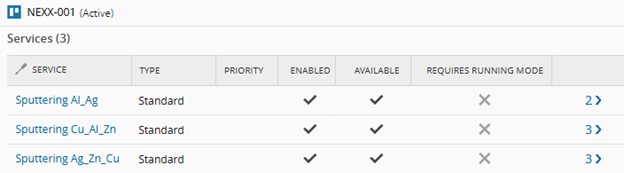
2nd) Each one of the services is required by different products

3rd) The Main service “Sputtering Al_Ag” requires the sub-services “Aluminum Deposition” and “Silver Deposition” provide respectively by the Chambers “CHB-001 or CHB-003” and “CHB-004”.
The Main service “Sputtering Cu_Al_Zn” requires the sub-services “Copper Deposition” and “Aluminum Deposition” and “Zinc Deposition” provide respectively by the Chambers “CHB-002”, “CHB-001 or CHB-003” and “CHB-005”.
The Main service “Sputtering Ag_Zn_Cu” requires the sub-services “Silver Deposition” and “Zinc Deposition” and “Copper Deposition” provide respectively by the Chambers “CHB-004”, “CHB-005” and “CHB-002”.
DEMO
Note: Since the Aluminum Deposition Service can be executed by two different chambers, whenever this service is requested, the MES Running Mode functionality can be leveraged to dynamically select and trigger the appropriate process recipe based on the specific chamber allocated for execution
Final thoughts
It’s a simple way to keep the line productive, even when equipment isn’t at full capacity.
Author
I’ve been with Critical Manufacturing since 2018, starting out as an MES Consultant. In 2025 I stepped into the Advocate & Architecture team. My role sits at the intersection of technology, communication, and strategy. Making sure solutions are technically sound and that everyone understands how to use or build them.
You can check me on LinkedIn